
It’s one of the most pivotal aspects of a motorcar, and yet it is often overlooked in favour of some of the louder and more exciting components; after all, you can’t get anywhere if you’re not pointed in the right direction. The steering rack allows our pilot to direct the car and our efforts past the finish line to victory!
 When one first learns to drive a motorcar, the most obvious and essential skill to master is that of steering a car successfully. Left and right, right hand down and left hand down. However, the effort required of the driver to turn the wheel needs to be minimized.
This happens when the efficiency of the steering mechanism in their car is maximized. Ultimately, a car is no good if its controls are too slow or too weighty, and so a lot of work from our engineers goes into ensuring the wheel slides effortlessly from lock to lock. But how does the fancy steering wheel of your car effortlessly turn an enormous piece of metal with little force applied from your end? To understand this, let’s look into the rack-and-pinion steering system.
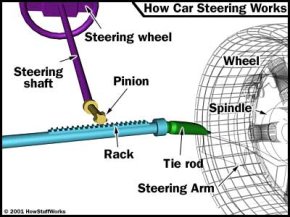
A pretty simple mechanism. A rack-and-pinion gearset is enclosed in a metal tube, with each end of the rack protruding from the tube. A rod, called a tie rod, connects to each end of the rack.
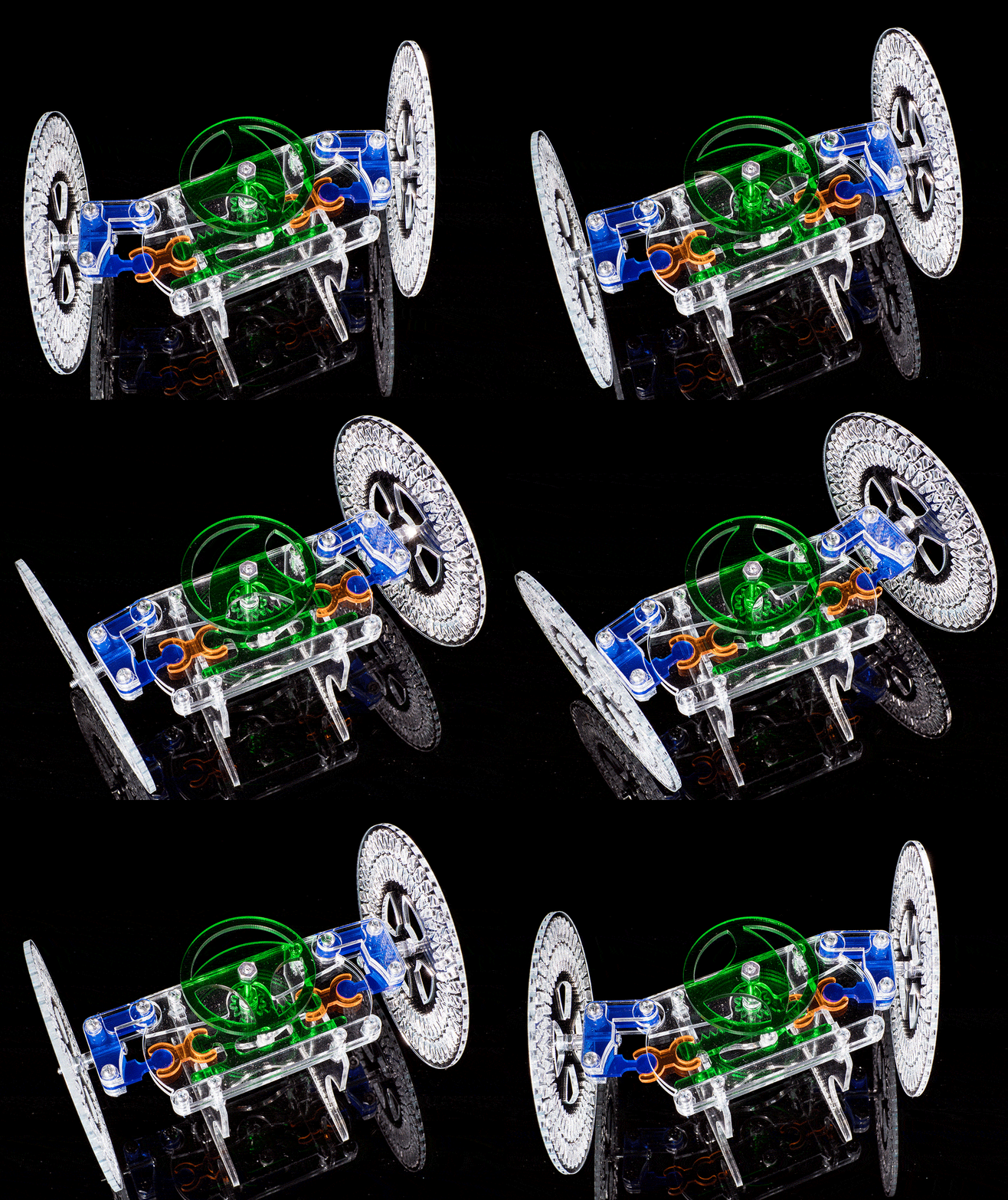 The pinion gear is attached to the steering shaft. When you turn the steering wheel, the gear spins, moving the rack. The tie rod at each end of the rack connects to the steering arm on the spindle allowing the wheels to turn (see diagram).
But why is the rack so important?
The rack-and-pinion gearset does two things; It converts the rotational motion of the steering wheel into the linear motion needed to turn the wheels & It provides a gear reduction, making it easier to turn the wheels.
In the FSUK competition, teams have two choices: To either mount high or low. When mounting high you get the most direct steering feedback and no steering linkages such as universal joiners are required. The centre of gravity is high in such a setup. With a low mount, universal joiners are used to transfer the steering torque through the necessary angles to meet the rack on the floor, such a setup is much safer in a crash for the driver and allows one to reduce the centre of gravity of the vehicle. Indeed, our engineers prefer the latter for these very reasons! However, the function of steering is not as simply achieved by just putting in a rack-and-pinion system in place, it is the underlying geometry that leaves even the best engineers perplexed.
Steering geometry in motorcars can be one of three types:
Parallel – To achieve this geometry, both steering arms are setup parallelly, which results in both wheels to be steered to the same angle. This is not the most preferable for an FSUK car, since if wheels turn parallel, in order to turn the corner the outside wheel will scrub. This will produce understeer in the car and has no notable performance benefits.
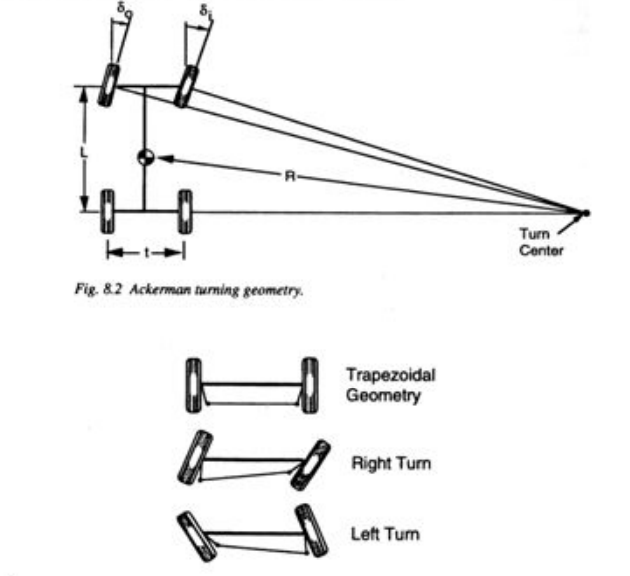 Ackerman Steering – If the steering arms are angled then this is known as Ackerman geometry (as shown in the diagram). The inside wheel is steered to a greater angle than the outside wheel, allowing the inside wheel to steer a tighter radius. The Ackerman setup is largely preferred for an FSUK car since this setup aims to minimise scrub which allows for less understeer and greater grip in tight radius low speed corners.
Anti-Ackerman (Reverse) – In such a setup the outside tire turns on a tighter radius than the inside. This can be seen to be used in F1 and faster race series. When a car is cornering, the outside tire is under greater load. This creates a larger slip angle on the outside wheel compared to the inside. With the Anti-Ackerman setup, the tightened radius of the outside wheel combats the greater slip angle and helps correct the path of the car, improving grip. However, this is not ideal for an FSUK car since the car is lighter and will be mostly cornering at low speed and thus won’t produce the loads necessary to justify such a setup.
So that’s all for today! Tune in next week for more insights into the magical elements that drive a car, meanwhile, I’m going out to effortlessly turn a titanic piece of metal and marvel at how strong I am!