

A motor car takes a lot of things to make it go. Some are obvious; they need wheels to receive power and put it down into the road. Some of them take a bit more thinking to appreciate, such as a differential or suspension. However, if anything is absolutely and patently clear as being required for a motor car, it is a motor.
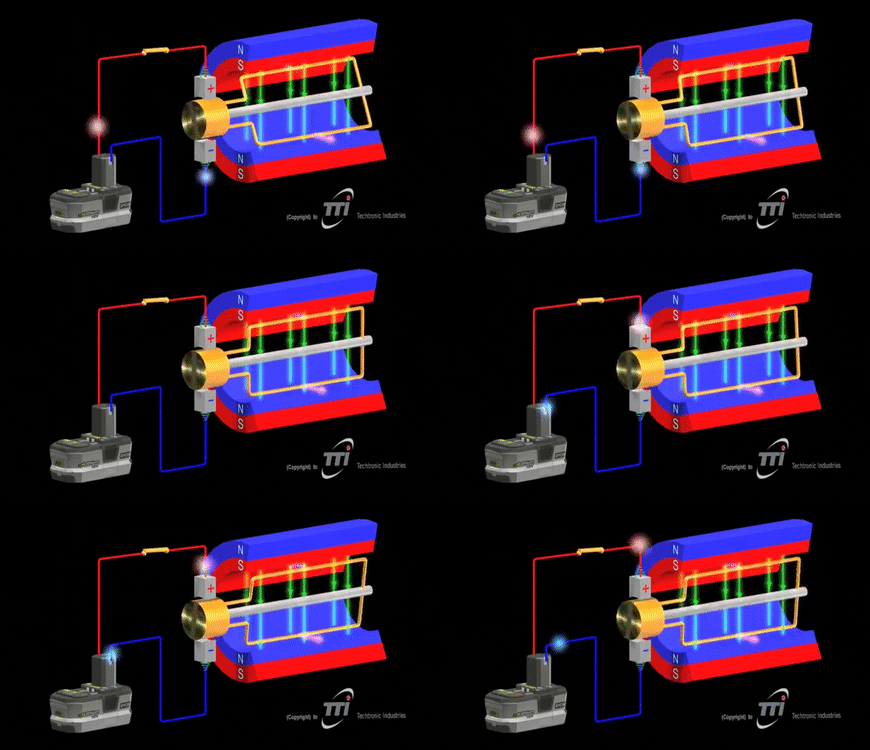 While the nature of this powerplant one can take into competition at Formula Student can vary between combustion and conduction, you have to have some way of powering your prototype.
If you want to make a freewheeling rolling chassis, go soapbox racing. We’re here to make some power.
But how to do that? At every stage, it’s a game of tradeoffs. Electric motors have maximum torque from the base of the rev range due to the lack of mechanical friction, which makes them brilliant in off the line acceleration tests, and they have no carbon emissions which means that sponsors are more likely to be attracted by what is seen as an emerging technology. However, internal combustion engines, which burn fossil fuel to force down a piston and turn a crankshaft, have greater energy density, and can as such be much lighter while giving out more absolute power, even if you need to be at a particular rpm, and use a gearbox, to make the most of it.
In addition, thousands of engines can be found all across the country and retrofitted into your Formula Student car, while EV motors are few, far between, and will generally cost a pretty penny. For a young team that is building their first ever car, we decided against the more ambitious electric motor, and instead went out in pursuit of ol’ reliable, the internal combustion engine.
 But which one? There’s hardly a shortage of internal combustion motors that have been made over the last century, and in 2017 we were spoiled for choice, but we did have some idea of the type of engine we wanted.
Naturally, we wanted to maximise the power output, but we also wanted to maximise the torque in the lower rev range, to allow us to compete against electric teams who can achieve maximum torque from the word go. One other thing we wanted to ensure our engine could do was have reasonably linear mid-range torque delivery up to 8000 rpm, essentially that the force being put through the wheels didn’t ramp up suddenly or drop away suddenly, as is prone to happen on some supercharged or turbocharged engines.
In addition, as boundary constraints, the series has a cap on certain elements of combustion engines to avoid an arms race that will price upstart teams such as ourselves out of the competition. Most relevant or our purposes is regulation CV1.1.1, which states that any such engine must use “a four-stroke primary heat cycle with a displacement not exceeding 710 cubic centimetres per cycle.” So, two main concepts there; four stroke, and engine capacity.
An internal combustion engine, unless it is a wankel rotary, will generally operate in either two or four “strokes”, or semirevolutions. These engines operate by having a circular piston travel up and down which, like the eccentrics we discussed a few weeks ago, translate from oscillating in simple harmonic motion to rotating about a crankshaft, which feeds out into a rotating shaft which can drive the wheels. Keen eyed readers will remember this animation to show how purely lateral movement is turned into rotation.
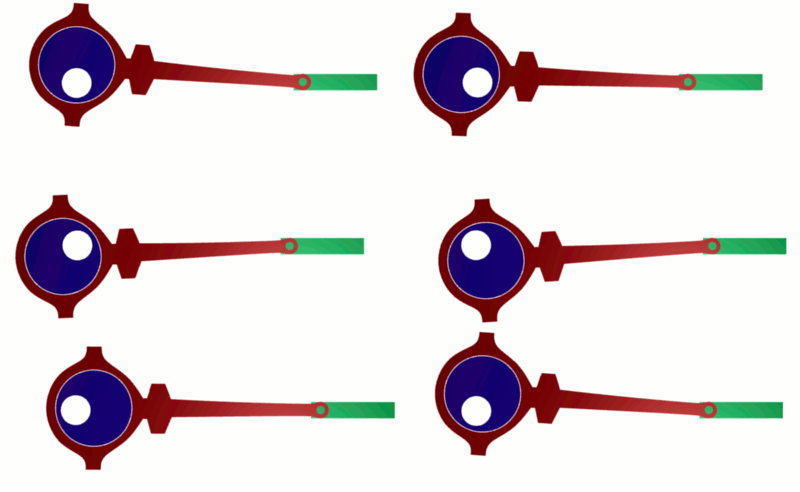
How to get the shaft oscillating like that in the first place is the subject of much contention, however the rules make this easier for us by specifying that the engine must be four stroke. With this system, a cylinder will have its base go through 720 degrees of rotation for every time it bangs, giving out power. For the first 180 degrees, the empty piston comes from top dead centre down to bottom dead centre, and the intake valve opens to allow air to flow into the newly opened space in the cylinder. Once the piston reaches the bottom, the intake valve then closes and momentum at the crankshaft carries the piston back up and compresses the air, squeezing it as tight as it can all the way back up to top dead centre.
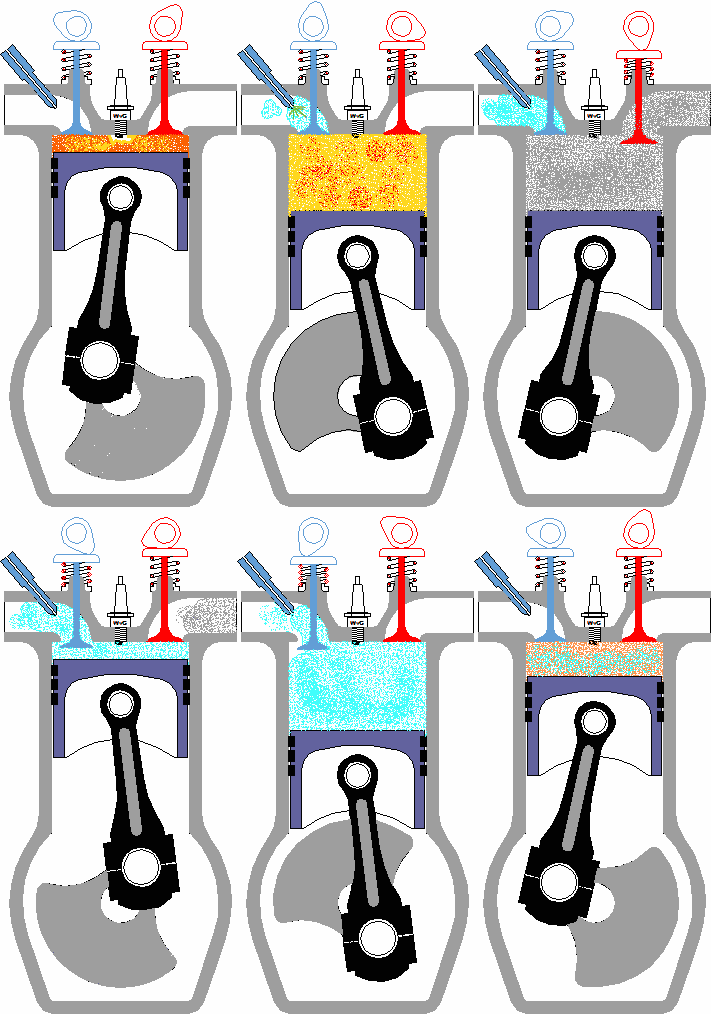 Just as the compressed air begins pushing the piston back down, a small amount of fuel is injected into the cylinder and the spark plug promptly lights up. As soon as it does, a spark ignites this fuel/air combination causing an explosion which pushes the piston down, which provides the force that turns the crankshaft, creates the power, and gives all the other cycles the momentum to keep turning against the resisting forces. Once the piston is pushed down to the bottom, the exhaust valve opens up, and all the noxious gas produced by the explosion can evacuate out up the cylinder.
Once the piston returns to top dead centre, all the gas has been evacuated, the exhaust valve closes, and the four stage cycle has finished. Suck, squeeze, bang, blow.
Naturally, if your engine is only one cylinder, having only one moment of power for every four turns of the crankshaft is less than ideal, and makes for somewhat juddering power delivery. However, if your engine has more cylinders, you can design your crankshaft to have each respective cylinder go off in a consistent manner that makes the gap between each bang smaller and smaller. A two cylinder engine can bang every 360 degrees rather than a single cylinder engine which is limited to every 720 degrees. A three cylinder can reduce this minimum gap to 240 degrees. With four cylinders, it can be pushed down to 180 degrees. With every additional cylinder, the delivery of power becomes that much smoother, with combustion stages being more regular.
But smoothness of power delivery is only one component to be considered; for a given size, the more pistons an engine has, the more wall surface the pistons will be rubbing against, which creates more mechanical friction, which in turn can cause the engine to be less free-revving. A multi-cylinder engine will also be heavier, not just because it has more pistons but because it has more intake valves, exhaust valves, camshafts, spark plugs, and wiring and plumbing for all of the above.
These are all questions that need to be considered when purchasing an engine, which on top of our initial requirements that it be less than 710cc, give high low-rev power and have consistent power delivery up to 8000rpm, helped us work to narrow down what engine we needed for our design. There weren’t that many car engines that small, and those that were were too poorly packaged to be practical.
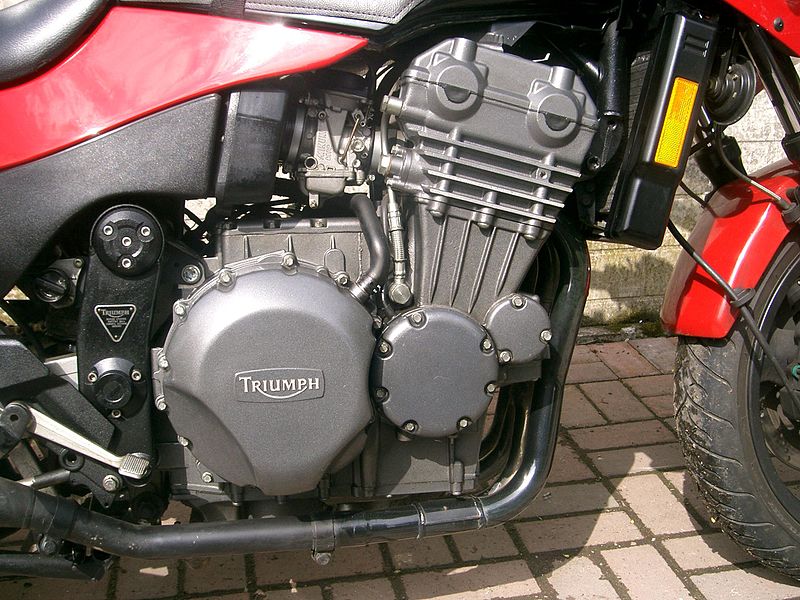 We needed a bike engine, and with a gradual process of elimination, the proud 2007 Triumph Daytona 675 won out, with it being just 35 cubic centimetres smaller than the maximum allowable, and it also has a higher power-to-weight ratio than competitors.
Furthermore, compared to them, the Triumph’s 3-cylinder profile offers a tighter rear packaging, which is key when trying to design a package that this engine is going to fit into.