

The human heart is a mighty thing. Our brains are similarly incredibly complex things, capable of immense feats. However, it is our skeleton that keeps us firm, that gives us shape and keeps us from flopping about like jelly. Similarly, with our racing car, the engine may give us power, and the suspension may give us stability, but it is only with the chassis that we can give our car shape, and ensure that everything has a fixed spine for everything to be mounted on.
However, much like our own skeleton for us, the chassis not only gives our car shape, but protects it from harm. Our skull protects our brain, and the bars of our chassis ensure that the internal components and, more importantly, the driver, remain safe from harm. However, to satisfy the regulations and ensure the driver is sufficiently safe, this chassis needs to be strong enough to withstand an impact at various points of a particular force. This can be remedied by placing more reinforcing bars at these areas, using thicker metal, or using stronger metal. In partnering with Aerocom to obtain T45, we’re going with that last one.
 The BS T45 tube specification comes from the UK, with it being originally developed during the First World War as axle tubing for the first warplanes, as it was strong, ductile and weldable without any heat treatment. Just weld it on and get back out there!
It still finds use in this field today, as our supplier, Aerocom, supplies it to restoration projects such as Spitfire and Hurricane fuselages, rollcages, and modern commercial aircraft interior structures. However, advancement over subsequent years saw the advantages of the material be used in other markets, and, although the specification has been in the process of being phased out since the 1980’s for materials such as titanium and purer carbon, it is still produced and used extensively in the UK today.
Indeed, this has been a little trouble for us. T45 isn’t sold in Ireland anymore, and so we needed to reach across the sea to source our much-needed tubing from Aerocom, who are a leading supplier of projects such as ours. Thankfully, they were able to help us source the metal we need.
But what is T45? It’s a good metal, but why is it a good metal? What makes it good? What, on a deeper level, is it? Well, to cut a long story short, it is a high tensile carbon-manganese cold drawn seamless tube.
Now that’s a lot of jargon, so let’s break it down piece by piece.
First of all, T45 is a high tensile steel. T45 is a kind of carbon steel, and a metal being high or low tensile refers to how much carbon there is in it as a percentage of its total mass. Mild steel generally has a carbon content of .15% to .20%, and by contrast high tensile steel can be up to .80% carbon. High tensile steel is stronger and more resistant to warping than mild steel, however it is also more brittle and prone to shatter.
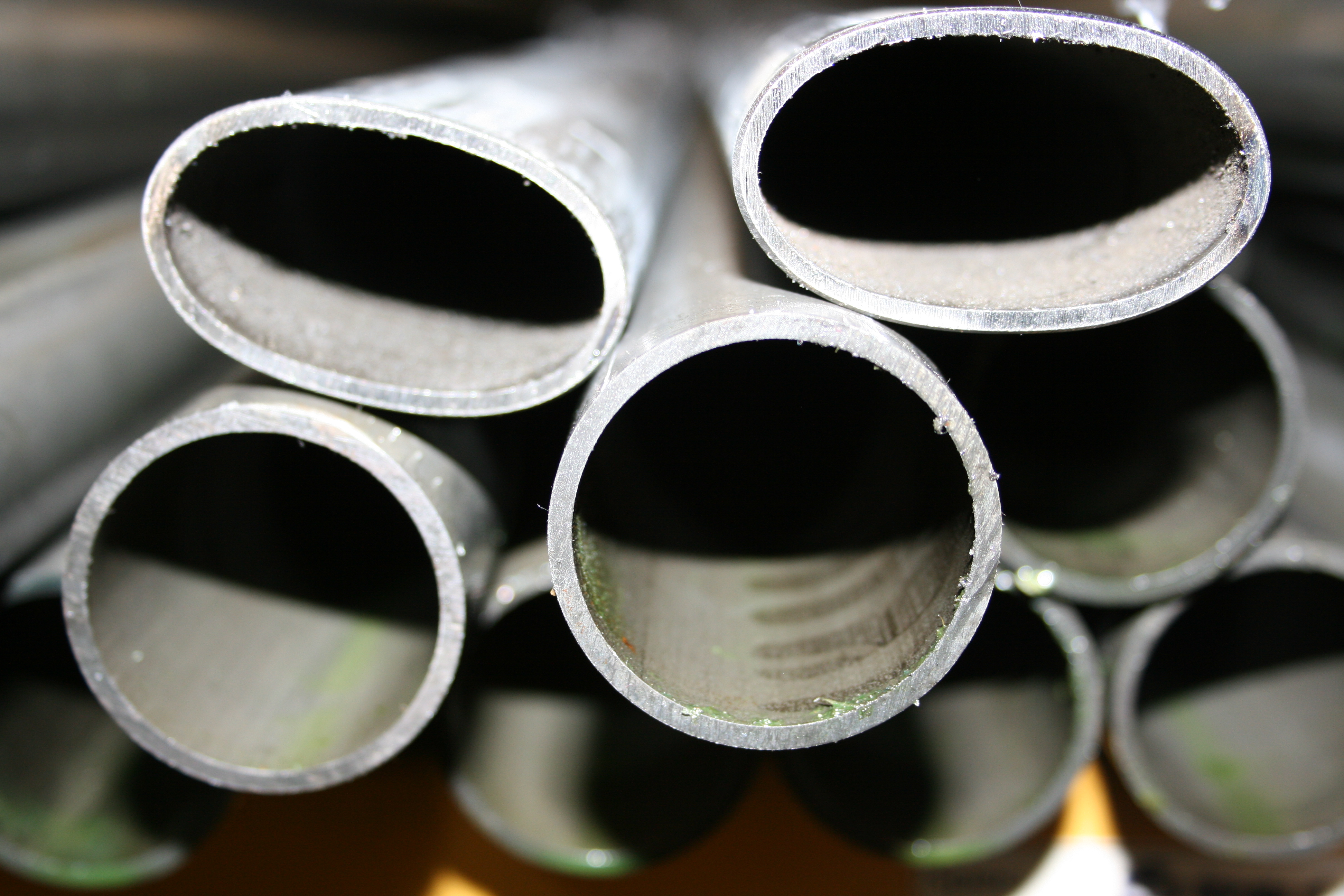 T45 is a cold drawn seamless steel. There are a number of metals that fall under the scope of cold drawn seamless, as the name refers to the means by which it is made. Here, tube is first carved out from a solid section of stainless steel.
This is then pierced with hot billets and subsequently rolled so as to elongate it, before it is through a die and over a mandrel plug to produce an accurate size and gauge. This is in contrast to rolled steel, where a strip that is bent over on itself and welded to be turned into a circular rod. Compared to this, cold drawn seamless steel has no seam or wounding at any point in the finished product, which increases the strength of the tube, making it very suitable for safety and performance critical applications.
In addition, due to the nature of the manufacturing process, drawn tubes can be manufactured to very exact dimensional tolerances, achieving consistent diameter and thicknesses throughout, since there is less expansion and contraction in the material compared to hot rolling, creating not only a more predictable finished product, but one which is more internally consistent, and subject to fewer internal imperfections.
Naturally, T45 is not the only cold drawn seamless metal. ‘Cold Drawn Seamless’ it is a term that can commonly be used for a long list of tubes. Alloys Steels like T45 and 4130 are CDS in nature, but it is more common in the market place that when people say CDS tube, they are referring to a more commercial and economically priced variant of a CDS tube such as E235+N.
 The difference between T45 tube and these other cold drawn seamless tubes, is their respective mechanical properties. The major chemical element of all of these steels is iron, and the differentiating factor is how they are alloyed.
For example, in T45 iron makes up 97% of the internal alloy material, with the additional elements such as carbon, silicon, manganese, and molybdenum giving them their uniqueness, alongside their varying thermal treatments. These varying factors determine the metals classification, as well as their ductility, strength, resistance to shatter, and ease of welding.
Out of these variables, T45 has emerged as one of the strong contenders where one needs a strong material for a lesser weight. This is not to say that it is lighter than other metals such as 4130; one of my own confusions while writing this was to think that T45 was less dense than other metals. This is not the case; it is not lighter for a given volume, but it is stronger for a given volume. This means you can use less of it to achieve a certain strength. This means in turn that rollcages and chassis made with it tend to be lighter, since you need less of it to satisfy the requirements for strength.
This, ultimately, why we use it for our chassis.