
In our work to design and build a car, it is not enough for us to design in a stylised way a dream car that looks cool and wows all the judges with its striking lines and bold appearance, as if it had leapt off the page of a Speed Racer comic. It is more critical to verify that these designs are effective, whether they are capable of withstanding the various stresses and strains that a race environment would put on them, that they are as light and as narrow as we can make them without compromising any of the strength that a racing car needs to operate. In addition, race cars are driven by humans, who must be protected from injury, and so it is vital to be able to run tests on the design to evaluate how well it can dissipate the violent energy put through it in a crash.
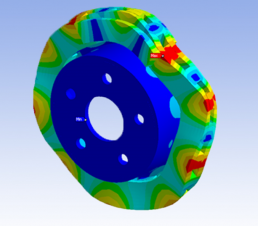
For all of these needs, comes the wonder of Finite Element Analysis, supported by ANSYS. First conceived by John Swanson in the 1960’s, this powerful platform is capable of incredibly intense, complex calculations that can break down, for any force on any point in a system, how the system will be stressed, showing us where it is weak and needs reinforcement, and where it is undergoing little strain and mass can be shaved off.
This is among the most powerful and valuable tools at our disposal. In a competition that is as much about the work of judging the distribution of finite resources as ingenious feats of lateral thinking in engineering and packaging, there is hardly a more valuable tool than one that can judge whether having a certain beam be wider or narrower is superfluously bulky and wasteful, fragile and insufficient, or perfectly balanced, using no more and no less material than is necessary.
To do these calculations by hand might take an age. ANSYS does it in an afternoon.
This is why we use ANSYS: just as much as its state-of-the-art numerical methods allow us to undertake incredibly complex calculations, important to us is how easy it is to use. From our designs in Solidworks, it is straightforward to import straight to a digital testing environment, extracting the wealth of data normally reserved to real-life testing. For groups that don’t have the sorts of resources to try every concept in a real life stress test, ANSYS’ accurate data allows the engineer, regardless of their resources, to shine.
And from there, the work of an engineer begins. Using clear data, the route to a solution diverges as solutions are conceptualised and compared according to their priorities. ANSYS allows our team to see the full picture, measure the designs, to make the important decisions with a clear understanding of the problem, allowing them to show how they uniquely solve a problem, whether it be by repackaging, the redistribution of struts, changing how they are angled, whatever they think is the best solution.
ANSYS empowers engineers with the understanding necessary to look at a problem and find their answer. It is in this way the great equaliser, as there is possibly no greater way to compare two engineers than to look at their diverging approaches to problem solving in the face of new information and unforeseen curveballs.
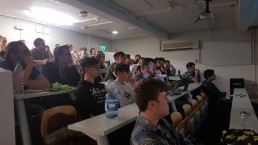
This is why it is so central to the work of not just Formula Trinity, but all students within the School of Engineering. Last year, Formula Trinity held a Tutorial, delivered by Colm O’Brien, for the student body on how to get the most out of the valuable software, teaching the basics for all in attendance, both Formula Trinity members and students interested in growing their skills, the basics of ANSYS FEA.
And this is only the beginning. Conor McElroy, as part of his masters thesis, was able to use the CFD functionality of ANSYS FLUENT to invest research into an aerodynamic package, with the software able to bridge the gap between fifty people in a building in the quieter end of a university and an industrial closed-return wind tunnel. Its capacity to calculate fluid dynamics is just another boon in its suite of numerical capabilities. Just as ANSYS is our virtual stress testing rig, it is also our virtual wind tunnel. It does the hard work of gathering data that would otherwise be inaccessible but for significant investment.
This point of placing engineers on a more equal footing, allowing their talents in adapting designs to meet unexpected curveballs to shine through, is made all the more pertinent in light of Covid-19. In a time when we must work at home, ANSYS, in conjunction with Solidworks, makes the task of designing and refining and optimising accessible from a home space. This technology, powerful enough to compute and analyse the structures that you have designed, is now usable from your desktop computer, and puts engineering into the hands of people at home, people like the many diligent, intelligent, and creative minds partaking in Formula Student, who will, for the time being, have to do their design work from home, and be met, thankfully, with software that is up for the task.
And so, we would like to thank ANSYS for sponsoring us. Their sponsorship of this project has allowed it to gain key insights into where we need to improve, and we would never have been able to come has far as we have without the insights the software has provided. Their decision to sponsor us looks to be an incredible asset going forward, and we look forward to the future with them alongside us!